
What Is a Shot Timer? The Complete Beginner's Guide to One of Shooting's Most Important Training Tools
Created at:
Walk into any practical shooting competition — IPSC, USPSA, IDPA, 3-Gun — and you'll notice something every serious competitor has clipped to their belt or tucked into their gear bag. It's small, it beeps, and it seems to command the entire stage. That device is a shot timer, and if you're new to the shooting sports, understanding what it does and why it matters could be the single most important step you take toward becoming a better, faster, more competition-ready shooter.
This guide covers everything a new shooter needs to know about shot timers — what they are, how they work, what the numbers mean, how to use one in training, and what to look for when buying your first one.
A Little Background: Why Timing Matters in Shooting
Shooting accurately is one skill. Shooting accurately under time pressure is a completely different one — and it's the skill that competitive shooting tests.
In practical shooting sports, your final score isn't just about hitting the target. It's about hitting the target fast. The scoring formula used in most disciplines combines accuracy points with your elapsed time to produce a final score. That means a shooter who fires fast but sloppy can lose to a shooter who fires deliberate and clean — and a shooter who is both fast and accurate will almost always win.
Speed, in this context, doesn't mean rushing or being reckless. It means eliminating wasted movement, hesitation, and inefficiency from your technique. Every tenth of a second you shave off your draw, every unnecessary pause you eliminate between shots — these add up. Over a full match with multiple stages, the difference between a podium finish and an average score often comes down to fractions of a second accumulated across dozens of individual moments.
The shot timer is the tool that makes those moments visible.
What Is a Shot Timer?
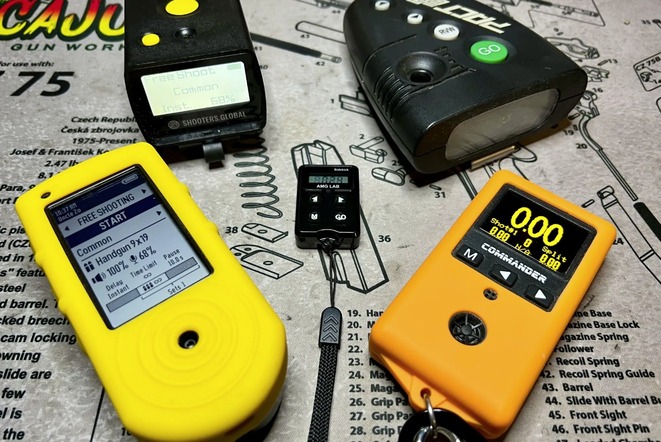
A shot timer is a small, handheld electronic device with three core functions:
- It produces a start signal — a loud audible buzzer that tells you when to begin shooting
- It detects the sound of your shots through a built-in acoustic sensor
- It records the exact time each shot was fired, down to the hundredth of a second
After your shooting string is complete, the timer displays a full breakdown of your performance. You can scroll through every shot and see exactly when it happened relative to the start signal. That data is the foundation of data-driven shooting improvement.
Shot timers are used by competitive shooters at every level — from brand new competitors running their first club match to world champions fine-tuning their technique for international championships. They're used by law enforcement and military personnel in firearms training. They're used by instructors teaching new shooters the fundamentals. And increasingly, they're used by recreational shooters who simply want to track their progress and train with purpose.
How Does a Shot Timer Work?
The core technology inside a shot timer is an acoustic sensor — essentially a highly sensitive microphone — that listens for the sharp, sudden sound of a gunshot. When it detects that sound, it logs a timestamp. It does this for every shot in your string, creating a precise timeline of your entire shooting sequence.
Modern shot timers have become impressively sophisticated in how they distinguish gunshots from other sounds. A good timer can filter out background noise — other people talking, brass hitting the ground, range commands — and focus specifically on the distinctive acoustic signature of a muzzle blast. High-end models can even filter out shots fired by other shooters nearby, so the timer only captures your rounds and not your neighbor's.
The sensitivity of the sensor is usually adjustable. In a quiet indoor range, you might set sensitivity high to catch even the softest sounds. At a loud outdoor match with multiple stages running simultaneously, you'd dial it down so the timer doesn't misread another shooter's rounds as yours.
Most modern timers are capable of detecting:
- Full-power rifle and pistol calibers
- Rimfire rounds like .22 LR
- CO2 and airsoft guns
- Suppressed firearms
- Dry fire — the click of a firing pin on an empty chamber
That last one — dry fire detection — is particularly significant for training purposes, which we'll cover in detail later.
Understanding the Numbers: What the Timer Is Telling You
When you look at your shot timer after a string of fire, you'll see a series of numbers. Here's what they mean:
Draw Time (First Shot Time) This is the time from the start buzzer to your first shot. It measures how fast you can get your firearm out of the holster, establish a grip, align your sights, and break your first shot. For a beginner, draw times of 2–3 seconds are common. Competitive intermediate shooters often draw in 1.2–1.8 seconds. Advanced competitors at the national and international level regularly draw under one second.
Split Times A split is the time between consecutive shots. If your first shot lands at 1.5 seconds and your second shot lands at 1.8 seconds, your split is 0.3 seconds. Split times tell you how fast you're managing recoil, reacquiring your sights, and resetting your trigger between rounds. Tight, consistent splits indicate good recoil control and trigger discipline. Wide or inconsistent splits indicate hesitation, poor grip, or sight alignment problems between shots.
Total Time The total elapsed time from the start buzzer to your last shot. In competition, this is one of the key numbers that feeds into your final score.
String Review Most timers allow you to scroll through every individual shot time in a string, so you can pinpoint exactly where things slowed down. Did your splits tighten up mid-string? Did you hesitate before your last shot? The data tells the story.
Learning to read and interpret these numbers is a skill in itself — but it's a skill that pays off quickly. Once you understand what the timer is telling you, every training session becomes a feedback loop rather than just repetition.
Par Time: Training With a Goal
One of the most useful features on any shot timer is par time. This function lets you set a target time for a drill. When you activate par time, the timer buzzes to start your string as usual — but it also buzzes a second time when your preset time expires.
The concept is simple but powerful. Instead of just shooting and looking at your time after the fact, you're training toward a specific goal in real time. If your first shot lands before the second buzzer, you hit your par. If not, you know you need to improve.
Here are a few examples of how par time is used in practice:
- Draw drill: Set a 1.5-second par and work on getting your first shot off before the buzzer fires
- Two-shot drill: Set a 2-second par and practice drawing and firing two accurate rounds within the window
- Transition drill: Set up two targets and use par time to push yourself to engage both targets faster
- Reload drill: Set a par time for your reload speed and work to beat it consistently
Par time creates urgency. When you know a second buzzer is coming, your brain engages differently than it does in open-ended practice. That urgency is exactly what competition feels like — and training under it prepares you for the real thing.
Sets and Structured Drill Sessions
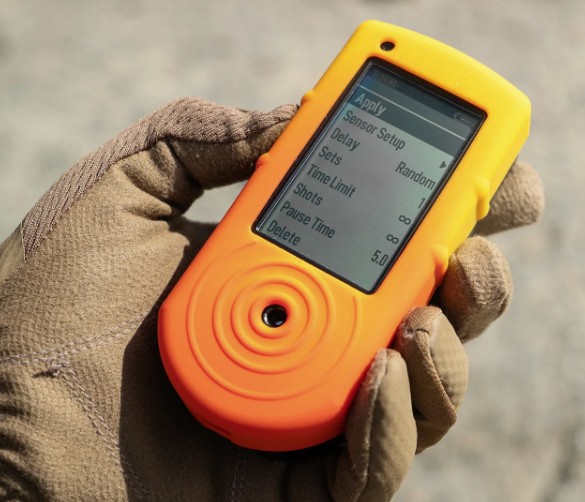
Advanced shot timers take par time a step further with a feature called sets. A set is one complete timed sequence — a start buzzer, your shooting string, and an end signal. With multiple sets, you can chain several repetitions of a drill together into one structured session, with programmed rest periods between each run.
For example, imagine you want to run a Bill Drill — drawing and firing six rounds as fast as possible — ten times in a row, with a fifteen-second reset between each run. Instead of manually restarting the timer ten times and trying to remember your times, you program ten sets with a fifteen-second pause between each one. The timer handles all of it automatically and logs every set together so you can compare them side by side.
This kind of structured session training is how serious competitors practice. It removes the administrative overhead of manual timing, keeps your rest periods consistent, and gives you a complete performance picture across multiple reps rather than just a single snapshot.
Shot Timers and Dry Fire Training
Dry fire is the practice of running your firearm through its mechanical functions — drawing, aiming, pressing the trigger — without live ammunition. It's one of the most effective and cost-efficient ways to develop shooting skills, and it can be done at home in your living room at no cost.
A shot timer that detects dry fire is an extraordinarily valuable training tool because it brings the same data feedback to home practice that you get at the range with live ammunition. Every dry fire rep is timed. Every trigger press is logged. You can run thousands of draw-to-first-shot reps over weeks and months and watch your times improve incrementally — all without spending a dollar on ammunition or range fees.
For a new shooter who is working on building fundamental skills — draw stroke, trigger press, sight acquisition — dry fire with a timer is arguably the fastest path to improvement available. You can do twenty minutes of deliberate, timed dry fire practice before work every morning and see measurable gains within weeks.
Always follow strict dry fire safety protocols — verify the firearm is unloaded, remove all ammunition from the room, and treat the firearm as if it were loaded throughout the session.
Shot Timers in Competition: The Range Officer's Tool
At sanctioned matches, the shot timer isn't just a personal training device — it's an official piece of equipment. The Range Officer (RO) uses the timer to give the start signal for every competitor's run and to record the official elapsed time for the stage.
This is why shot timer reliability matters so much in competition. A timer that misreads a shot, fails to detect a round, or malfunctions mid-stage can result in a reshoot — which disrupts the match flow and is frustrating for everyone involved. Range officers depend on their timers the same way a referee depends on a stopwatch.
Modern timers designed for competition use include features specifically aimed at the RO role — the ability to connect to official match scoring software, modes that lock the timer to a specific user's shots in a multi-shooter environment, and interfaces that make entering and reviewing data fast and efficient on a busy stage.
Smart Shot Timers and App Integration
The latest generation of shot timers connects to smartphone apps via Bluetooth, opening up a level of training analysis that was simply not possible with older hardware. Here's what app-connected timers can do:
Automatic session logging. Every drill, every rep, every session gets saved automatically. Over time, you build a complete performance history that lets you see long-term trends — are your draw times improving month over month? Are your splits getting tighter? The data answers those questions.
Video with shot data overlay. Some timer apps let you record video of your training and overlay the shot timestamps directly onto the footage in real time. You can watch your draw and literally see the split times appear on screen as you fire. This makes it immediately obvious whether you're losing time in your draw stroke, your grip, your recoil management, or your target transitions.
Remote control. You can start and stop the timer from your phone — useful when training alone and you want to set up at the target line without having to walk back to reset the timer.
Drill libraries. Many apps include pre-built drill programs based on established training standards — Bill Drill, El Presidente, the Mozambique Drill, and others. You can select a drill, set your goals, and the app guides you through the session.
Match integration. Some timers sync directly with match scoring platforms like PractiScore, which is used at USPSA and IPSC matches across the country. Range officers can record times directly through the integration and push data to the scoring system in real time.
Performance comparisons. Run the same drill ten times and compare every set side by side. See if your performance degrades as fatigue sets in, or whether you're more consistent in your first reps than your last.
None of these features are required for a beginner — the basic timer functions work just fine without any app at all. But as you advance and start looking for marginal gains, the data available through modern app integration is genuinely useful.
Do New Shooters Really Need a Shot Timer?
Some new shooters hesitate to introduce a timer early, feeling like they should focus on accuracy first and worry about speed later. This is an understandable instinct, but it's based on a misconception.
A shot timer doesn't force you to shoot fast. It measures how fast you're shooting — whatever that speed happens to be. There's nothing stopping you from using a timer while shooting slowly and deliberately. The data you get is still valuable: it shows you consistency, it reveals hesitations you weren't aware of, and it builds the habit of performing under a start signal.
More importantly, introducing the buzzer early removes the psychological weight it carries for newer shooters. If you've never trained with a start signal, stepping up to a stage at your first match and hearing that buzzer can be genuinely disorienting. Your hands move differently, your mind goes blank, your carefully practiced technique evaporates. This is called "stage fright" or "timer brain" in the shooting community, and it affects nearly every new competitor.
The cure is simple: train with a timer from the beginning. The more reps you have under a start signal, the more natural it feels. By the time you get to a real competition, the buzzer is just another familiar sound — not a trigger for anxiety.
What to Look for When Buying Your First Shot Timer
The shot timer market has grown considerably in recent years, with options ranging from budget-friendly basic models to advanced smart timers packed with features. Here's what to prioritize when choosing your first one:
Shot detection range and sensitivity. The timer needs to reliably detect your shots from the position you'll be wearing it — typically on your belt or in your hand. Make sure it covers the caliber you shoot and can handle the environments you train in.
Echo and interference filtering. If you train at busy ranges, a timer that can filter out nearby shots is a significant quality-of-life improvement. Without this, you'll get false reads that muddy your data.
Par time functionality. This should be considered a baseline requirement, not a premium feature. Any timer you buy should have par time.
Buzzer volume. You need to hear the start signal clearly through hearing protection. Look for a timer with a loud, crisp buzzer — at least loud enough to cut through foam earplugs or muffs.
Battery life and charging. Some timers run on standard AAA batteries. Others use rechargeable lithium batteries with USB-C charging. Either works, but USB-C rechargeable models are more convenient for regular training.
Ease of use. You should be able to navigate the basic functions — start, review shots, set par time — quickly and intuitively. If it takes five minutes to figure out how to start a drill, the timer is getting in the way of training.
Durability. The timer will live on your belt at outdoor ranges in heat, cold, humidity, and dust. Look for a water-resistant, rugged build.
App connectivity (optional but valuable). If you're serious about tracking your progress long-term, Bluetooth connectivity and a companion app is worth the investment. If you just want a reliable timer to get started, standalone models work perfectly well.
Price. Basic shot timers start around $50–$80 and cover all the fundamental functions a new shooter needs. Mid-range models with better sensors and par time run $100–$150. Premium smart timers with Bluetooth, app integration, and advanced features run $250–$350. Buy within your budget — even the most affordable timer is infinitely better than no timer at all.
Common Shot Timer Mistakes New Shooters Make
Ignoring the data. The whole point of a shot timer is the numbers it gives you. If you shoot a string, glance at the total time, and move on without analyzing your splits, you're leaving most of the value on the table. Take an extra thirty seconds after each string to review the breakdown.
Chasing speed before accuracy. The timer measures speed, but speed without accuracy is worthless in competition. If you're dropping shots trying to beat your split times, slow down. Clean hits at a moderate pace will outscore fast misses every time.
Not using par time. Many new shooters use their timer purely in review mode — shoot, check time, repeat. Par time training is dramatically more effective because it creates goal-oriented pressure. Set aggressive but achievable pars and work specifically toward beating them.
Only using the timer with live fire. As mentioned above, dry fire with a timer is one of the highest-return training investments available. Don't restrict your timer to the range.
Comparing yourself to advanced shooters' times. When you see a world-class competitor post a 0.9-second draw or 0.12-second splits on video, it can feel discouraging. Those numbers are the result of years of deliberate practice. Focus on your own baseline and measure your improvement against where you started.
The Bottom Line
A shot timer is not a luxury item for competitive shooters. It's a fundamental training tool — as essential as a quality holster or a consistent ammunition load. It transforms vague practice into measurable work, turns feelings into facts, and gives you something that no amount of unsupported range time can provide: objective data about your performance.
Whether you're preparing for your first local club match, working toward a classification goal in USPSA, or simply committed to becoming a more capable and confident shooter, a shot timer belongs in your gear bag.
Start measuring. Start improving. The numbers don't lie.